As a writer, I’ve never really liked metaphors–or similies for that matter–and I’m not sure whether it’s because I’m not clever enough to come up with them or that they feel contrived. Most things, I think, are what they are and don’t compare well to something else. I’m not ever sure why one would need to compare things, anyway. Does the comparison help you to understand the thing observed better? Like I said, contrived.
Spring sneaked up on me, and I wasn’t paying attention until it was full on summer. That’s when I saw that my crepe myrtle bush–the one that got chopped in half during Hurricane Helene last September and had its dead half hacked off and thrown with no mercey on the burn pile. In that moment, I debated sawing off the half clinging crookedly to its little section of earth and decided to simply trim it back and see what happened.
Here’s what happened: it bloomed. And bloomed some more. Even the little straggly parts near the bottom of the poor thing have beautiful purple flowers on them. Beat all to hell by nature–a freaking tree fell on it–broken in half, mind you, reduced to a couple of crooked sticks, and it bloomed. I took one look at it and thought, If that’s not a metaphor for my life, I don’t know what is.
All I want to say about that is that my life right now looks nothing like what I thought it would. Can I leave it at that?
In the eighties, After I got immersed in my beautiful career in south Florida, I invited Gloria Steinem to speak at a women’s empowerment event at Palm Beach Community College. Fortuitously, it happened to fall on election day 2000—the one where George W. Bush became President because Palm Beach County’s ballots were so confusing that people of average or lower intelligence messed them up. The recount ended up taking so long that the Florida Supreme Court declared the winner and we tipped the electoral college votes to Bush. Al Gore, with his high ideals about saving Planet Earth conceded.
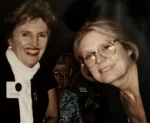
But back up just a day or two: In the middle of the recount, Gloria spoke at our event. She was inspiring, funny, and genuinely warm, but I don’t remember exactly what she said because before the applause died down, we started asking her if she could do anything about the recount and the hanging chads, and she went calmly to work rallying the important people she knew to see if she could get some clarity. She stayed with us even though she had other engagements. She was amazing. We were in a panic, even then knowing that the planet couldn’t afford a Bush presidency, but she posed for a photo with me. And I found it today, forty years later, while cleaning up, so that when I die the kids aren’t faced with a mountain of stuff that means nothing to them.
The day I met Gloria Steinem came rushing back. I remember everything about it—the mood of sheer terror over the election, the passionate commitment to feminism and progressivism, the fight for diversity, equity, and inclusion, even though those terms weren’t a thing yet. Freedom and justice for all. Tolerance of difference, kindness for people less fortunate, empathy for people struggling to find a better life, hope that women would be able to find their way onto the arena, that they would have a say, be heard, earn respect, show the world that they had a lot to contribute.
Instead, we went to war with the wrong country and set Iraqi women back hundreds of years. From a secular existence where they had a place in society, we condemned them to religious servitude and ignorance for all the years to come. No coming back from that.
Since then, have women in the US make any progress at all? Sure—at a glacial pace.
I thought I’d live to see a woman in the White House, and when we ran a person who had experience, wisdom, and brilliance, I knew the time had come. The most qualified human being in the entire country lost to a buffoon. Thanks to Russian trolls. And he’s back! Bested another woman—not as qualified, but certainly more dignified—back to do more extreme damage. He’s vengeful and petty this time and has surrounded himself with toadies who will sell their souls to kiss his ring. Environmental protection is of a thing of the past. We will put profit ahead of the survival of our grandchildren. We will burn fossil fuels, drill into the ocean, and we will pollute Earth until it is uninhabitable—by us, anyway. He will help us prove that homo sapiens don’t deserve this beautiful planet with its millions of exotic animals and vulnerable plant life. We are a failed experiment, I’m saddened to predict.
What does any of that to do with Gloria Steinem? Just this for me: It was a time of so much hope. I spent a day with a woman who, with so much class, fought the good fight and made me proud to have had my picture taken with her. I’m grinning in that picture, and I remember feeling that we could do anything then. I love remembering that day.


 Pat Ponders Life